
Reading List
John Kay
Economist and Financial Times Columnist
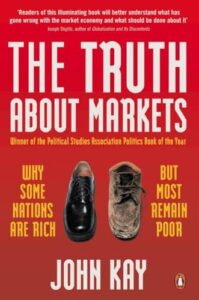
Sir John Kay is a British economist and a fellow of St John’s College, Oxford. He ran the Institute for Fiscal Studies, founded the consultancy London Economics, was the first director of Oxford’s Said Business School and has written a column for the Financial Times since 1995. His books include The Truth About Markets, Obliquity, Other People’s Money and, with Mervyn King, Radical Uncertainty. In 2012 he led a review of UK equity markets for the government.
01
 Amazon ↗
Local bookstores ↗
Amazon ↗
Local bookstores ↗
The Origin of Wealth
by Eric D. Beinhocker
“What’s good about it is that it is eclectic. I initially picked it up to write a review and was planning to do a hatchet job given that it had a ludicrously ambitious title and was by a McKinsey consultant. I then discovered it was actually very good.” — via Interview, October 2013
02
 Amazon ↗
Local bookstores ↗
Amazon ↗
Local bookstores ↗
Good Strategy Bad Strategy
by Richard Rumelt
“Most books about business strategy are indeed terrible. The great take away of this book is that good strategy is really just about structured thinking about problems. Rumelt is a brilliant expositor of how you can do that in relation to a range of business issues.” — via Interview, October 2013
03
 Amazon ↗
Local bookstores ↗
Amazon ↗
Local bookstores ↗
The Big Short
Inside the Doomsday Machine
by Michael Lewis · Business
“Lewis is a great writer and this is one of the best accounts of what happened in the run up to the crash. In fact, I just recommended it to someone I was with last night who was talking about the efficient market hypothesis – which is the basic paradigm of financial economics – and I told him that if he wanted to understand why it didn’t apply in the run up to the financial crisis, he needed to go away and read this book.” — via Interview, October 2013
04
 Amazon ↗
Guns, Germs, and Steel
by Jared Diamond · 1997 · History
“If you are brought up with the rationalist tradition of standard economics, you just never make the sorts of connections that Diamond makes.” — via Interview, October 2013
05
 Amazon ↗
Local bookstores ↗
Amazon ↗
Local bookstores ↗
The Wealth and Poverty of Nations
by David S. Landes · 1998 · Economics
“He provides an explanation for why Western Europe was the cradle for modern economic growth and looks at the development of the institutions that made modern economic development possible. Landes provides the best account I know of these kinds of developments.” — via Interview, October 2013