
Reading List
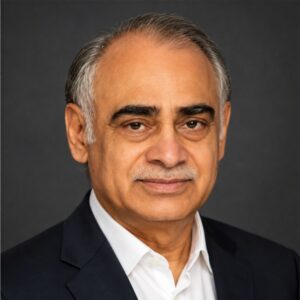
Ziauddin Sardar
Writer and Cultural Critic
Ziauddin Sardar has written and edited more than sixty books across Muslim thought, futures studies, postmodernism and the politics of science, which is why The Independent called him Britain’s own Muslim polymath and Prospect counted him among the country’s hundred leading public intellectuals. Born in Pakistan and raised in Britain, he read physics before turning to journalism, reported the Middle East for Nature and New Scientist, and launched the quarterly Critical Muslim in 2012. Desperately Seeking Paradise records his own long argument with the faith.
The Reconstruction of Religious Thought in Islam
by Muhammad Iqbal
“The book presents an alternative vision of a dynamic, thriving future civilisation of Islam. It starts with an observation that is also a glaring dichotomy. Given that Islam is perforce a future-orientated world view, why is the future so conspicuously absent from contemporary Muslim thought and discourses? So – single-handedly for almost a decade – I tried to shape a current discourse on Islamic futures.” — via Interview, June 2010

Meetings with Remarkable Muslims
by Barnaby Rogerson and Rose Baring
“They are just farmers, taxi drivers, asylum seekers, cleaners, musicians, mothers or teachers. Yet they are living extraordinary lives. Take the story of ‘Mr F’ who survives the Taliban in Afghanistan, only to suffer unmitigated humiliation as an asylum-seeker in Britain, or Youssou N’Dour who rises above poverty in his native Senegal, to travel to France and woo people with his devotional Islamic songs.” — via Interview, November 2009

The Travels of Ibn Battutah
by Ibn Battutah
“Wherever he went, he found it easy to get employment as a jurist, or a courtier or an ambassador. His journeys involve swashbuckling adventures and chases with concubines in tow. He is a riveting read. The interesting thing with Ibn Battutah is that travel for him was not just going from one place to another; it was living in a place. Wherever he went, he made his home. He had a house, he married and he got a job.” — via Interview, November 2009

Islam and the Secular State
by Abdullahi Ahmed An-Na’im
“The most urgent task facing Muslim society, I think, is the reformulation of the sharia. Here, the human rights lawyer Abdullahi Ahmed An-Na’im has provided an invaluable lead. He has written extensively on Islam and human rights. In this book he argues that Islam cannot have a viable future without rethinking Islamic law and the relationship between religion and the secular state in all Muslim societies.” — via Interview, June 2010
Islam
Past, Present & Future
by Hans Küng
“This is a monumental work: it covers the evolution and development of Islam, the present crisis of Muslim civilisation, and looks at what Küng calls ‘possibilities for the future’. Islam is the last in a trilogy which has also covered Judaism and Christianity. And Küng is simply brilliant in making connections between the three monotheistic faiths and highlighting the areas of convergence.” — via Interview, June 2010
The Road from Damascus
by Robin Yassin-Kassab
“The way that travel features in the book is very sophisticated; Robin Yassin-Kassab depicts the internal travel of the characters from one variety of Islam to another, the physical travel of literally going to Damascus, and also spiritual travel as certain characters find themselves spiritually enriched by their experiences.” — via Interview, November 2009

The Fugitive
by Pramoedya Ananta Toer
“The hero and protagonist Hardo is displaced despite living in his own home country, Indonesia, because of the fact that he is a colonial subject (it is written at the time of the Japanese occupation); both his physical and mental space is occupied by the coloniser. Hardo travels within his own country, in search of home.” — via Interview, November 2009

Travels with a Tangerine
A Journey in the Footnotes of Ibn Battutah
by Tim Mackintosh-Smith
“If you want to get a contemporary look on Ibn Battutah, then Tim Mackintosh-Smith is an excellent guide.” — via Interview, November 2009
The Future of Islam in the Middle East
by Mahmud A. Faksh
“Faksh looks at the future of Islamic fundamentalism in Egypt, Algeria and Saudi Arabia and concludes that it has no future. Faksh offers a refreshing and powerful analysis of the vacuous nature of Islamic fundamentalism. He is very far sighted but his book is largely neglected. I think it deserves to be read and re-read.” — via Interview, June 2010

The Future of Islam
A New Edition
by Wilfrid Scawen Blunt
“It should not come as a surprise to discover that the first book on the future of Islam was written by an Englishman: Wilfrid Scawen Blunt. Blunt was an accomplished Orientalist, and wrote a numbers books on the Middle East. He was also a close friend of Jamaluddin Afghani, the famous 19th-century Muslim reformer of Egypt.” — via Interview, June 2010