
Reading List
Branko Milanovic
Economist, Scholar of Global Inequality
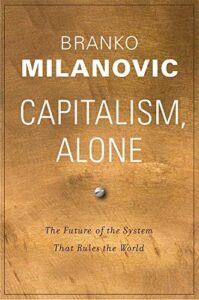
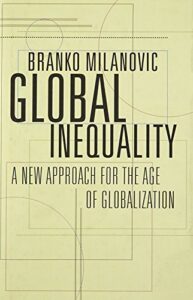
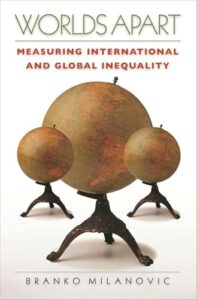
Branko Milanovic is a Serbian-American economist and a leading scholar of income distribution and inequality. He spent many years as a lead economist in the World Bank’s research department and has been a research professor at the Graduate Center of the City University of New York since 2014. His books include Worlds Apart, on measuring global inequality, The Haves and the Have-Nots, Global Inequality, which tracks who gained and who lost from globalization, and Capitalism, Alone, which compares the liberal and political forms of capitalism now competing for the world.
01
 Amazon ↗
Local bookstores ↗
Victoires et déboires
by Paul Bairoch
“This is a magisterial three-volume economic history of the world from Columbus to Gorbachev. Bairoch covers the entire economic history of the world and he provides lots of numbers, estimates and, at times, indeed guesses, but lots of numbers nevertheless on many things like income, wages trade, urbanisation, income distribution, population and so on. This is crucial for economic historians who want to build on these numbers.” — via Interview, January 2011
02
 Amazon ↗
Local bookstores ↗
Contours of the World Economy, 1-2030 AD
by Angus Maddison
“Maddison is the only person who has produced the only existent series of quantitative national account statistics, GDP per capita, for most countries of the world since 1820, and for some (like the Roman Empire) going back to the 1st century AD. Everybody who wants to do empirically based economic history has to start with Maddison.” — via Interview, January 2011
03
 Amazon ↗
Local bookstores ↗
The End of the Past
by Aldo Schiavone
“Schiavone’s answer is that the main culprit was the existence of slave labour. Most of the slaves in Rome were the product of military conquests. Slaves were relatively expensive, meaning that they could produce output above their own subsistence, but they were not sufficiently expensive to encourage the use of labour saving, and thus more technologically productive, techniques. Slavery, as argued already by Marx, was the key reason why ancient societies could not go past a certain level of economic development (even if they knew of some technologies – most famously the steam engine invented in Alexandria). They developed well enough to know how to use slaves but didn’t develop sufficiently to make it profitable to replace them with machines.” — via Interview, January 2011
04
 Amazon ↗
Local bookstores ↗
Imperialism
by J. A. Hobson
“A classic on imperialism, published a hundred years ago. It shows how unequal distribution of income in the metropole implied a high concentration of free (investable) financial capital in the hands of few people, and a drift toward imperialism.” — via Interview, January 2011
05
 Amazon ↗
Local bookstores ↗
The Law of Peoples
by John Rawls
“Rawls is different. He’s the first modern political philosopher (probably since Kant) that tried to answer the question of how just relations between nations and individuals should be organised in a philosophical sense in the era of globalisation. Here we really have the rules of how the world should be run.” — via Interview, January 2011