
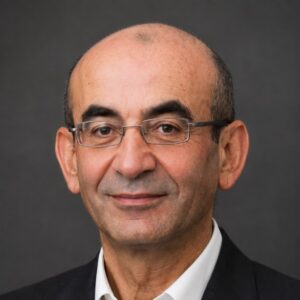
Portrait of Raja Shehadeh
Reading List
Raja Shehadeh
Lawyer and Author
Raja Shehadeh is a Palestinian lawyer and writer who lives in Ramallah and co-founded Al-Haq, one of the first human rights organisations in the region.
Palestinian Walks (2007) records six walks taken in the hills around Ramallah over twenty-seven years, and the landscape’s transformation between them; it won the Orwell Prize. His other books include the diaries When the Bulbul Stopped Singing, Strangers in the House, Occupation Diaries, Where the Line Is Drawn and We Could Have Been Friends, My Father and I.
He writes as a lawyer as much as a memoirist, and the legal framework of occupation runs through the work.
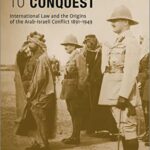
From Coexistence to Conquest
International Law and the Origins of the Arab-Israeli Conflict, 1891-1949
by Victor Kattan
“I’m a lawyer as well as a writer so I’m interested in the legal aspects of the Palestinian conflict. Many books look at the legal side and many more at the history. This book combines the two: Kattan believes you can’t understand one without the other. I absolutely agree with him.” — via Interview, February 2011

Footnotes in Gaza
by Joe Sacco · Graphic Novel
“This is an amazing, graphic and emotional book. Sacco writes about the massacres carried out by the Israeli army in the Gaza Strip in 1956. He completed the book in 2003 so it resonates with the present. It’s really about memory: how it can fool you and change things. He sifts through the memories of the witnesses he meets in Gaza to get to the truth of the two atrocities – one in Rafah, the other in Khan Younis.” — via Interview, February 2011

My Happiness Bears No Relation to Happiness
A Poet's Life in the Palestinian Century
by Adina Hoffman
“She had to face up to what her adopted country had done in 1948 and what happened to the Palestinians who stayed in Israel. She studied Arabic in order to read the poetry and speak with Ali and his family in their own language. She wanted to get behind the façade and she does a tremendous job. Literature became a way for Palestinians in Israel to preserve their identity. The book charts a difficult journey.” — via Interview, February 2011

Mural
by Mahmoud Darwish · Poetry
“The village where he was born was destroyed in 1948. He started writing poetry when he was very young. He later became a communist and was very active politically, although he spent some time in prison. Palestinians living in Israel until 1967 endured a military government and there were many restrictions on their lives. Darwish went abroad to study and stayed away. Leaving Israel was a difficult decision for him.” — via Interview, February 2011

After the Last Sky
Palestinian Lives
by Edward Said
“The full line is: ‘Where should we go after the last frontiers, where should the birds fly after the last sky?’ It’s very evocative. At the end, Said writes: ‘I would like to think that we are not just the people seen or looked at in these photographs: we are also looking at ourselves.’ He wants to distance himself from those who see the Palestinians as passive or as mere objects to be scrutinised.” — via Interview, February 2011