
Reading List
Niall Ferguson
Historian and Author · Hoover Institution
Niall Ferguson is a Scottish historian who writes on finance, empire and catastrophe, and a senior fellow at the Hoover Institution. He has held chairs at Oxford, Harvard and the London School of Economics.
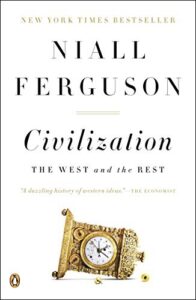
The Pity of War (1998) questioned the necessity of British entry into the First World War; The Cash Nexus (2001) and The Ascent of Money (2008) traced the history of money and credit. Empire (2003) and Civilization (2011) accompanied television series of the same names, and Doom (2021) examined how societies respond to disaster.
He has also written biographies of the Rothschilds, of Siegmund Warburg and of Henry Kissinger.

War and Peace
by Leo Tolstoy · 1869 · Fiction
“I suppose that, as a middle-aged man, I react differently to Tolstoy than I did when I first read War and Peace at about 15. At first reading, I was entirely captivated by the concluding essay at the end of the book, where Tolstoy writes about historical determinism. I bought that then, and it was only really in my twenties that I rebelled against it.” — via Interview, April 2012

An Autobiography
by R. G. Collingwood
“Collingwood was a very eclectic thinker. He did both archaeology and philosophy, and his insight that historians are re-enacting – even recreating – the past is very profound. He has a great line about historians seeing the tiger in the long grass.” — via Interview, April 2012

The Last Days of Mankind
by Karl Kraus · Drama
“It’s a tremendously modern work in the way that it represents the relationship between the media and warfare. And much of it isn’t written by Kraus at all, but is quotation of articles from the period. So to somebody who was already interested in the First World War, that was a very exciting revelation. I was also excited by Kraus’s language. Even in translation, it is clear that he was an extraordinary writer.” — via Interview, April 2012
A Tract on Monetary Reform
by John Maynard Keynes
“Part of the reason why we had deficits in the first place is that tolerance of deficits had come into Western economics through vulgar Keynesians. I use the term “vulgar Keynesian” deliberately, because I think Keynes would be rather appalled at the way his name is used these days to justify policies that are reckless.” — via Interview, April 2012

The Wealth of Nations
by Adam Smith
“Obviously it’s somewhat different in our time, but essentially what Smith grappled with was the instability of banks and the risk of bank runs. What happened to Northern Rock [in 2007] happened to the Ayr bank [in Scotland in 1772]. Smith also looked at ways in which the state, by intervening, can make matters worse.” — via Interview, April 2012