Reading List
Alison Gopnik
Professor of Psychology, University of California, Berkeley
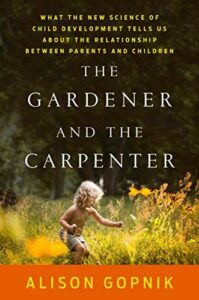
Alison Gopnik is a professor of psychology and affiliate professor of philosophy at Berkeley, where she studies how children learn. She was among the first to argue that a baby’s mind is not a defective adult one but a different instrument altogether, built for exploration, and she applied Bayesian networks to the question of how infants work out cause and effect. The Scientist in the Crib, The Philosophical Baby and The Gardener and the Carpenter carried that research to general readers, alongside a decade of Wall Street Journal columns.
01
 Amazon ↗
Local bookstores ↗
The Child’s Discovery of the Mind
by Janet Astington
“Again, the traditional wisdom is that children are egocentric and have a hard time taking the perspective of other people, and they don’t understand the difference between the mind and the body. All this comes from Piaget, and in fact what Janet Astington does in this book is to summarise a whole lot of studies that show how sophisticated even young children are in their understanding of the mind.” — via Interview, August 2012
02
 Amazon ↗
Local bookstores ↗
The People in the Playground
by Iona Opie
“What I particularly love about the Opies’ book is that they did this beautiful scholarship, and their key message was that, instead of thinking of children as defective grown-ups, we should see schoolchildren as people who are also creating their own world and trying to understand the world around them. Also, they are often creating a world that is richer than the one we can imagine as adults.” — via Interview, August 2012
03
 Amazon ↗
Mothers and Others
The Evolutionary Origins of Mutual Understanding
by Sarah Blaffer Hrdy
“This is another book by an anthropologist, although, rather than being a social anthropologist like Alma Gottlieb, Sarah Hrdy is a physical anthropologist who looks at different types of primates. So she is looking at human babies from the perspective of evolution.” — via Interview, August 2012
04
 Amazon ↗
Local bookstores ↗
The Afterlife Is Where We Come From
by Alma Gottlieb
“This is a book by an anthropologist, and what she wrote is an anthropological account of babies and children in a very poor community in Africa. It is a beautiful and moving account of the relationships between the mothers and children in this community and how close they are, even when childhood is endangered.” — via Interview, August 2012
05
 Amazon ↗
Imaginary Companions and the Children Who Create Them
by Marjorie Taylor
“This is a book by one of the people who has been part of the new wave of research in cognitive development. What Marjorie did is to deal with a really fascinating phenomenon that all parents notice, which is the fact that children often have these imaginary friends who are very vivid and significant.” — via Interview, August 2012