
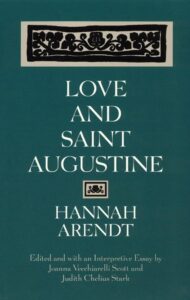
Love and Saint Augustine
Arendt was twenty-two when she asked what Augustine meant by love, and found three answers that refuse to reconcile. Her first book, and the last translated.
Arendt’s doctoral dissertation, written at twenty-two under Heidegger and Jaspers and revised across the rest of her life, asks what Augustine actually meant by love, and finds three incompatible answers in him: love as craving, love as the creature’s relation to its creator, and love of neighbour. It is the book where her later political thought about worldliness and amor mundi is already visible in embryo, and the last of her works to appear in English.
Recommended by 1 Person

Maria Popova
How to heed Augustine’s caution, not by subjugating but by better understanding our experience of love, is what Hannah Arendt (October 14, 1906–December 4, 1975) explores in her least known but in many ways most beautiful work, Love and Saint Augustine (public library) — Arendt’s first book-length manuscript and the last to be published in English, posthumously salvaged from her papers by political scientist Joanna Vecchiarelli Scott and philosopher Judith Chelius Stark.
As an Amazon Associate, bookstoread.org earns from qualifying purchases. Links to Amazon on this page may earn us a commission at no extra cost to you. Spotted an error on this page? Tell us and we will fix it.