
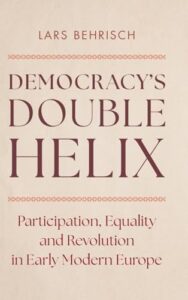
Democracy’s Double Helix: Participation, Equality and Revolution in Early Modern Europe
Semi-democratic decision-making began, Behrisch argues, not from any ideal of representation but from the practical business of assembling armies and raising money.
Behrisch locates the roots of semi-democratic decision-making in sixteenth-century Europe, arguing that it emerged from the practical need to assemble military and fiscal coalitions rather than from any ideal of representation. Rulers needed money and men, and had to bargain for both. The geographic range is wider than most comparable studies, which is where the argument gets its force.
Recommended by 1 Person

Tyler Cowen
A good book about how the roots of semi-democratic decision-making are found in 16th century Europe, and stemmed from new needs to assemble various military and fiscal coalitions. Looks at the problem more broadly, in geographic terms, than most comparable studies.
As an Amazon Associate, bookstoread.org earns from qualifying purchases. Links to Amazon on this page may earn us a commission at no extra cost to you. Spotted an error on this page? Tell us and we will fix it.