
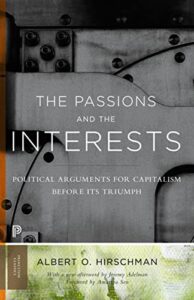
The Passions and the Interests
Political Arguments for Capitalism before Its Triumph
How the pursuit of gain was reclassified from vice to civilising force in the century before Adam Smith.
Hirschman traces how the pursuit of money was reclassified between the sixteenth and eighteenth centuries: from a vice, to a calm ‘interest’ that might restrain the more dangerous passions, and so to a civilising force. The argument for capitalism, he shows, was originally political rather than economic, a way of taming princes. A short book with a long afterlife.
Recommended by 1 Person

Robert J. Shiller
In medieval times, the dominant intellectual tradition was one of sin and the avoidance of sinful behaviour. Lust for power or wealth were unambiguously bad things. Even in a feudal society, such passions were acknowledged by society as, in some sense, legitimate, but the view didn’t have any authority. In the Renaissance, the authority of these self-denial concepts began to recede.
Interview · January 2018
As an Amazon Associate, bookstoread.org earns from qualifying purchases. Links to Amazon on this page may earn us a commission at no extra cost to you. Spotted an error on this page? Tell us and we will fix it.