
Reading List
Jeffrey Sachs
Economist and Professor at Columbia University · Columbia University
Jeffrey D. Sachs is an American economist known for his work on extreme poverty, development and sustainability. He directed the Earth Institute at Columbia University and has served as special adviser to three United Nations Secretaries-General.
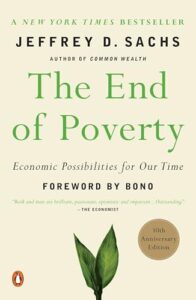
The End of Poverty (2005) argued that the poorest countries are caught in a trap that targeted investment can break, and set out the case behind the Millennium Development Goals. Common Wealth (2008) took up population, climate and shared resources; The Price of Civilization (2011) turned to the American economy; and The Ages of Globalization (2020) traced seven eras of connection between societies.
He led the UN Millennium Project and directs the Center for Sustainable Development at Columbia.
Manifesto Global Economic Ethic
Consequences and Challenges for Global Businesses (German/English edition)
by Hans Küng & Klaus M. Leisinger
“What Küng has done, with a lot of colleagues and building on a lifetime of work where he has studied all the major religions, is to put forward the proposition that during the last 20 years at the core of all these great religions, despite their frequent conflicts, there is actually a common set of values which can be the basis for a true global ethic.” — via Interview, September 2010

We the Peoples
The Nobel Lecture Given by the 2001 Nobel Peace Laureate
by Kofi Annan
“Of course, I am especially attracted to this powerful document because it is the place where the world leaders adopted the Millennium Development Goals. It’s in that context that Kofi Annan challenged the world leaders to adopt specific time-bound development goals. And they were adopted in the Millennium Summit in 2000 and that started this 15-year process of which we are now in the tenth year.” — via Interview, September 2010

Ethics for the New Millennium
by Dalai Lama
“Of course, I am very attracted to the Dalai Lama for many aspects of his wisdom and Buddhist ideas and overwhelmingly about the need to put compassion at the centre of our lives and at the centre of our global thinking. Not only to help those in need but actually to help ourselves, because it is the core principle of the Dalai Lama that the way to our own happiness is by attentiveness and compassion to others.” — via Interview, September 2010